
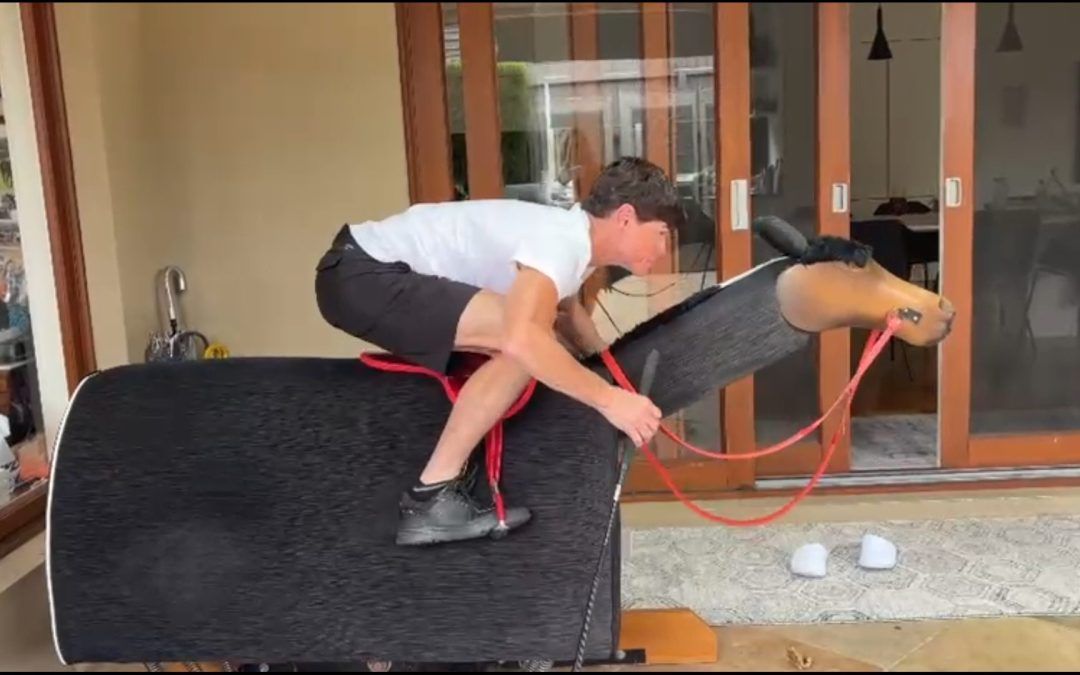
Williams, has offered an in-depth look at how subtle changes in jockey positioning can dramatically influence a racehorse’s balance, stride efficiency, and overall form — all demonstrated on an Equicizer training simulator.
Speaking during a recent training session, Williams used the Equicizer — a stationary mechanical horse widely used for rider education — to break down the biomechanics behind race riding. While race-day tactics often draw the spotlight, Williams emphasized that posture and weight distribution are foundational elements that directly affect a horse’s performance.
The Neutral Racing Position
Williams began by demonstrating the classic “neutral” racing seat — a light, balanced crouch with heels down, hips aligned over the saddle, and hands carried steady just above the withers.
“In this position, your weight is centered,” Williams explained. “You’re allowing the horse’s back to lift and its stride to flow naturally.”
On the Equicizer, he showed how even pressure through both stirrups creates symmetry. When balanced correctly, a jockey minimizes interference with the horse’s natural head carriage and spinal movement. According to Williams, this position maximizes efficiency, particularly during cruising speed in mid-race stages.
Forward Shift: Increasing Momentum
Next, Williams subtly moved his upper body forward, lowering his chest closer to the horse’s neck — a position commonly seen during acceleration phases.
The shift may appear minor, but on the Equicizer, the impact was clear. By moving his center of gravity slightly ahead, Williams demonstrated how a jockey can encourage forward momentum. However, he cautioned that overcommitting can place excessive weight on the forehand.
“If you tip too far forward, you risk unbalancing the horse,” he said. “It can shorten the stride and put pressure on the front legs.”
Such imbalance can affect not only speed but also long-term soundness, particularly in high-pressure finishes.
Sitting Taller: Regaining Control
Williams then transitioned into a more upright seat — similar to the posture used when restraining a horse or preparing to navigate tight turns.
This adjustment shifts weight marginally toward the horse’s hindquarters, helping rebalance a runner that may be overstriding or leaning. On the Equicizer, Williams demonstrated how engaging the core and sitting taller stabilizes the upper body without pulling unnecessarily on the reins.
“It’s not about hauling back,” he said. “It’s about redistributing your weight so the horse can reorganize underneath you.”
This technique is often deployed when settling a keen horse early in a race.
Lateral Balance and Cornering
One of the most instructive moments of the session came when Williams illustrated lateral imbalance — a common but often overlooked issue.
By applying slightly more pressure into one stirrup, he showed how a jockey can inadvertently cause a horse to drift or lose efficiency around turns. On the Equicizer, the exaggerated demonstration highlighted how even a small hip misalignment can disrupt straightness.
“At racing speed, these small shifts become magnified,” Williams noted. “Your body has to stay centered, especially around bends.”
Maintaining even shoulder alignment and steady rein contact, he explained, allows the horse to remain balanced through its ribcage and hindquarters when cornering.
The Invisible Influence
Williams stressed that elite race riding is often about what spectators cannot see. While whipping technique and timing attract public attention, balance and posture operate continuously throughout a race.
“The best rides often look effortless,” he said. “That’s because the jockey isn’t fighting the horse — they’re moving in harmony with it.”
Using the Equicizer as a teaching aid, Williams underscored how riders can refine muscle memory without placing strain on a live horse. For apprentices and developing jockeys, the simulator provides a controlled environment to master the fundamentals of form.
As racing continues to embrace sports science and biomechanical analysis, Williams’ demonstration serves as a reminder that success in the saddle begins with balance — a principle as critical at trackwork as it is under race-day pressure.